
How Pred-D turns machine behavior into earlier maintenance insight
This page walks through the approach at three levels — what the system does, how it works, and what deployment looks like.
What the system does
Pred-D continuously listens to machine behavior using physics-based sensors. When behavior changes in ways that indicate developing damage, it surfaces an actionable signal — early enough for planned maintenance rather than emergency response. No cloud dependency is needed for core detection, ensuring operation even in isolated environments.

System architecture
1. Machine Signals
Vibration, acoustic emission, temperature acquired at the asset
2. Edge Node
30-pin ESP32 with dedicated sensor bus allocation
3. Local Extraction
Physics-based feature extraction and topological analysis on-device
4. Swarm Collaboration
Node-to-node comparison validates anomalies without a central controller
5. Maintenance Insight
Actionable, confidence-qualified signal delivered to operations
The architecture flows from the asset to operations: machine signals are first acquired and sent to the 30-pin ESP32 edge node. Local physics-based feature extraction and topological analysis occur on-device. Nodes then use swarm collaboration to compare data and validate anomalies without needing a central controller. Finally, an actionable maintenance insight is delivered directly to operators.
Core capabilities
Local Processing
Benefit: No cloud dependency for detection.
Mechanism: Feature extraction runs on the ESP32 edge node.
Constraint: Computational budget limits model complexity per node.
Physics-Informed Interpretation
Benefit: Fewer false alarms than purely statistical methods.
Mechanism: Signal analysis grounded in mechanical failure physics, not just pattern matching.
Constraint: Requires domain-specific signal models per asset class.
Autonomous Operation
Benefit: Functions in connectivity-limited environments (marine, remote).
Mechanism: Each node maintains its own baseline and detection logic.
Constraint: Fleet-level insights require periodic data sync.
Swarm Collaboration
Benefit: Distributed validation reduces single-node false positives.
Mechanism: Group-theoretic invariants enable nodes to cross-validate anomaly signatures.
Constraint: Network topology affects consensus latency.
Integration Path
Benefit: Works alongside existing maintenance systems.
Mechanism: Standard output formats for CMMS, historian, and alert systems.
Constraint: Integration scope depends on site infrastructure.
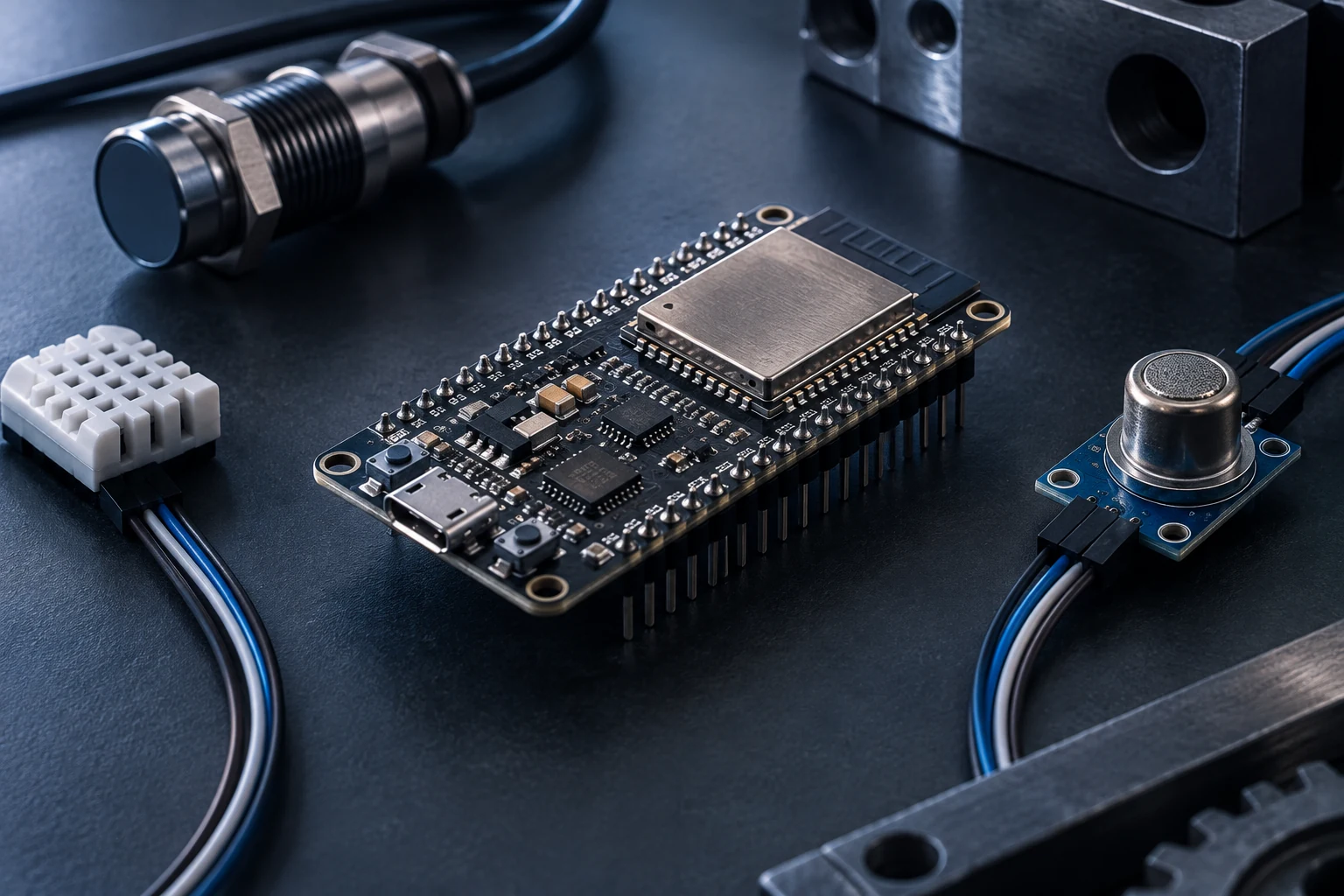
Hardware: the swarm node
The Pred-D swarm node is engineered around a 30-pin ESP32 architecture featuring multi-sensor bus allocation for parallel acoustic, vibration, and thermal acquisition. Designed for harsh industrial environments, it features a compact form factor ideal for mounting on or near monitored assets.
- Multi-sensor bus for parallel data acquisition
- Edge-level physics-based processing
- Peer-to-peer mesh communication
- Industrial-grade environmental tolerance
- Compact mounting form factor
- Low power consumption
Deployment workflow
Here is how a typical deployment progresses from installation to continuous monitoring.
Install
Mount the swarm nodes on or near the target assets and establish the mesh network.
Baseline
Nodes autonomously learn the healthy operational physics and dynamic ranges of the asset.
Monitor
Continuous edge-level topological analysis is performed on incoming multi-sensor data.
Investigate
Deviations from the physics-based baseline are locally identified as potential anomalies.
Validate
Nodes cross-reference using swarm invariants to filter out isolated false positives.
Maintain
A confirmed, actionable signal is dispatched for planned maintenance.
Technical questions
Can it use our existing sensors?
While standard sensors can sometimes be integrated, our system relies heavily on a specialized multi-sensor bus allocation for parallel acoustic, vibration, and thermal acquisition that enables accurate topological analysis at the edge.
What happens if connectivity is lost?
Our autonomous operation capability means the system continues to monitor and log anomalies locally without relying on a cloud connection. Fleet-level syncs happen once connectivity is restored.
Does the system need calibration?
Initial physical models are tailored to the asset class. Beyond that, the node establishes its own continuous baseline autonomously, minimizing the need for manual recalibration.
How are false positives handled?
We leverage swarm collaboration via group-theoretic invariants. Instead of relying on a single sensor's threshold breach, nodes cross-validate anomalies, significantly reducing false positive rates.
What about cybersecurity and data handling?
All core processing runs on the edge node. By eliminating cloud dependency for detection and using localized peer-to-peer mesh communication, we drastically reduce the external attack surface.
What are the environmental limits?
The hardware is built with industrial-grade environmental tolerance, tailored for punishing environments like commercial marine propulsion systems and slurry pipelines.
Can it integrate with our CMMS or maintenance system?
Yes. The final output is an actionable, confidence-qualified signal provided in standard formats that smoothly integrate with existing CMMS and alert systems.